
Spiritual Attachments as Probability 1 Beliefs
Or: Buddhists advocate Pure Bayes, while Christians Commit to Decision Variables

When Rationalist Pope Eliezer Yudkowsky says “thou shalt not use 0 or 1 as probabilities”, he is pointing to the same truth as the First Noble Truth of Buddhism. Understanding the math will help you understand a core difference between Buddhism and Christianity, not in terms of metaphysical claims, but as cognitive operating systems.
I’ve been circling this for a while now. Some recent posts, and you lovely readers’ comments on them, helped me lock this idea in. Two reader comments on Bayesian Updates Require Ego Death stood out, in seeming opposite directions. Putting those comments together lead to the synthesis.
Reader AG pointed out that it’s precisely the non-Bayesian updates that require ego death:
I don't think this is the case if the prior is a probability distribution instead of a certainty, because then updating is just a shift instead of a full reversal. It's actually updates in a non-Bayesian framework that this really applies to.
This is an excellent point. It’s the non-Bayesian updates that get you. It’s only when your sense of identity is totally inflexible on some belief that changing the belief feels like dying.
Eliezer Yudkowsky argues that a probability of 0 or 1 is effectively an ‘infinite prior’ , which can’t be shifted by evidence. That means your only option when confronted with contrary evidence is to reject the evidence — and hence, according to Buddhism — suffer. When you have a probability 1 belief that you won’t be hungry, you suffer when you experience hunger because you can’t integrate the evidence that you are, in fact, hungry.
This comment dovetails with a separate comment made by Cactus Brahmin:
I would note that there is a lot of alpha in consciously holding the tension, localized to different layers, for various reasons. The collapse of everything back into reality, all at once, is called death (as you note) – so anything living is, in some sense, working against that. Proper spiritual (and cultural) practice is about cultivating complex, subtle metabolic processes more than anything else.
His point is that ego death is on a continuum with actual death. This is absolutely true and something I planned to address. Your brain keeps you alive by trying to maintain some relationship between a ‘you symbol’ and an ‘environment symbol’. It’s absolutely useful to keep in mind the reality that you aren’t the symbol. But at the same time, if you let go of any constraints on the ‘you symbol’, you’d just sit passively while watching yourself starve to death.
Rather than trying to release all tension, you can hold tension on purpose, by choosing a probability 1 belief. This is what I was getting at in Free Will as Precision Control: we can think of intentional choices as being decision variables which are not subject to evidentiary updates. If I commit to not eating processed carbs, I don’t interpret cravings as evidence. I see them as temptation and choose to experience the tension of rejecting them, rather than relieving the tension by grabbing the pizza.
If you feel hungry and reach for food without thinking, you’re reacting. Your brain is trying to pin that ‘I will be hungry’ probability to zero, and moving the motor cortex to try and minimize the conflict between expectation and reality. When you sit still and endure the hunger, you’re letting go of the probability, letting it float up from zero.
You can think of ‘ego’ as a constellation of beliefs with probability 1 (or 0), such as “I won’t be hungry,” “I will be comfortable,” etc. Choosing to endure that tension temporarily will, in the long term, lower the tension you’ll experience in situations of hunger. This works by allowing that part of the ego to ‘die’, by transitioning from zero odds to non-zero odds of hunger. Doing this reduces the power hunger has over you, because you’re accumulating evidence that you can endure hunger. Buddhists are absolutely right about this fact.
What is generally left out is that doing this indefinitely, of course, will kill you. Letting go completely requires dying.
This is where Christianity and Buddhism diverge.
Buddhism’s main goal is the elimination of suffering. Christians are supposed to choose suffering, by emulating Jesus carrying his cross. Mahayana Buddhism offers the Bodhisattva, someone who delays their own enlightenment to help others — but the goal is still eliminate suffering, not “live fully.”
Christianity says we are not supposed to transcend suffering, by ‘dying’, either literally, or else figuratively by withdrawing to an environment that’s so regular that our predictive processing model can converge on a solution. We’re supposed to choose suffering, on purpose, instrumentally towards love of the Truth, first, and the care and well being of others, second.
This sounds strange or archaic, but there’s a good mathematical reason for this. When Jesus is asked “What is the most important commandment,” he shocks everyone by answering the question. He doesn’t speak vaguely, he gives a clear ordering: Love God, first. Love your neighbor, second.
When you understand that God means ‘Truth’, you’ll see that Jesus is saying is “Even loving your neighbor has to be subservient to your absolute commitment to the Truth.” This commitment to the Truth ultimately requires suffering, because you need an ego to survive, and you suffer when your ego confronts reality and fails.
Everyone agrees: Your map is flawed. You can either try to ignore that, give up on having a map, give up on trying to live fully, or keeping following your map to its edges, getting hurt, and then updating your map and trying again.
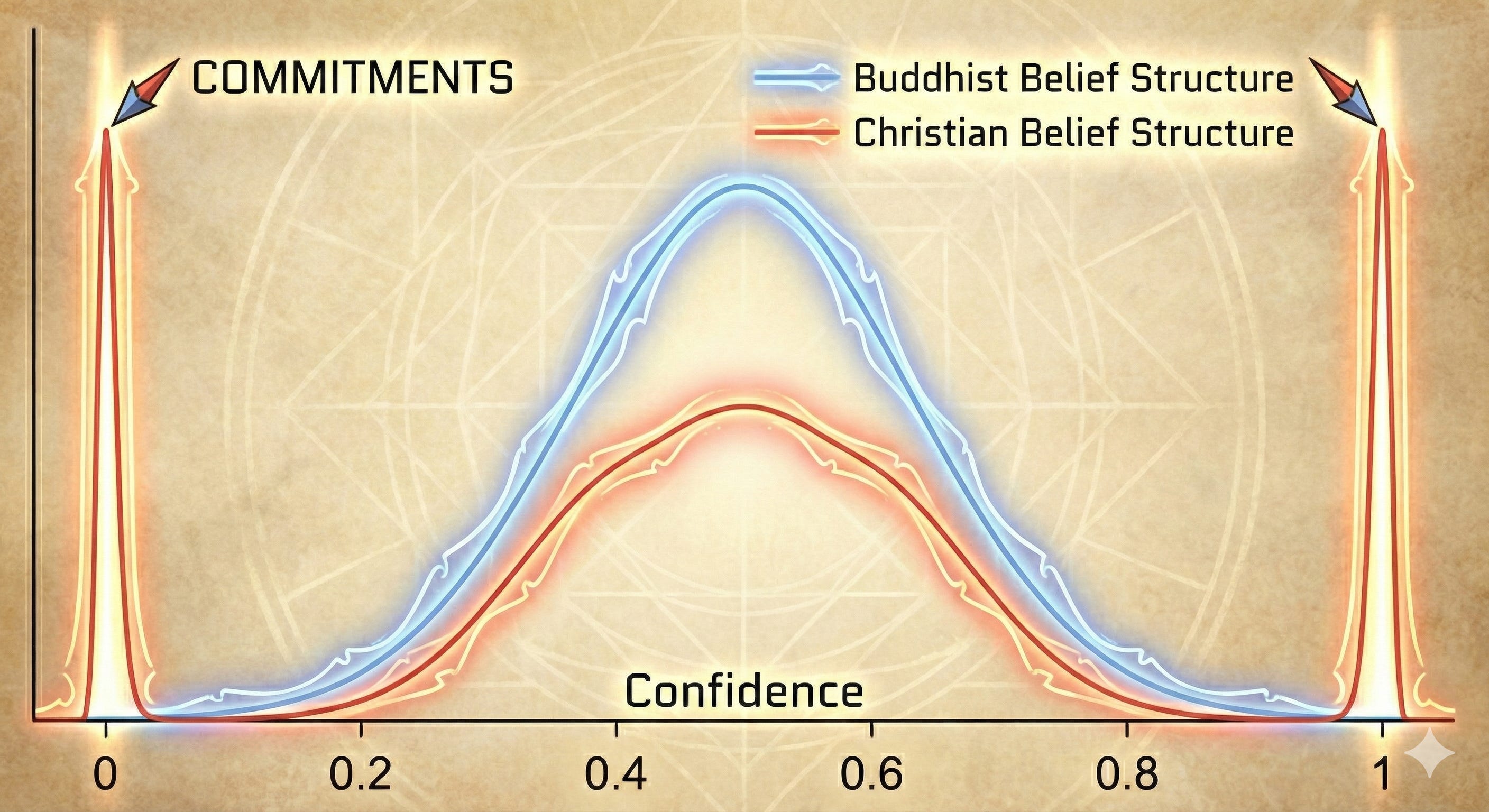
Rather than rejecting all probability one beliefs, Christianity asks you to make commitments, i.e. choosing to say “I will never do this”, or , “I will definitely do this”. Yes, you’ll suffer from these commitments. Especially when you fail to keep them, which you inevitably will.
The prize Christianity offers is not “no more suffering”, it’s “you will be maximally alive.” What Christianity offers isn’t a coupon redeemable only upon death, but a life trajectory that is narrow, yes, but narrow in the same way a laser beam is narrow because it is coherent.
Practicing Love of God first, and Love of neighbor second, expands your conception of self. Your ego becomes coherently integrated with a whole, rather than merely erased — or, worse, hidden from your view. If you want to see a demonstration of ego, take two ‘spiritual teachers’ who say they’ve eliminated ego, and ask them why they disagree.
Suffering, rather than being meaningless pain, can become the conduit that keeps a noisy primate brain in communion with a dynamic reality rather than a comforting story.
Buddhism does a phenomenal job of articulating the interior mechanisms of suffering and provides a real, genuine recipe to transcend that suffering.
But it’s worth asking whether some things are worth suffering for. If the answer is ‘yes’, we have to ultimately reject both the premise that ‘elimination of suffering is the highest goal’, and thus idea that 0 and 1 aren’t valid probabilities.
They are, but only for those who choose suffering — for those who commit, knowing the cost.
I get tripped up on this part “When you understand that God means ‘Truth’”…seems like very much a flattening of the concept of God. Though it makes the framework much easier to follow IMO.
Or perhaps I’m asking the question of what do you mean by Truth?
Great post, I think the way these ideas are explored is truly unique. Quite a feat at this stage of the internet.
Faith is exactly this capacity to hold beliefs to a degree beyond their actual justification. For some people this is harder than others, which is why many reasoning types born into a faith will often spend inordinate amounts of effort attempting to manufacture evidence for their beliefs. On the other hand, reasoning types who convert to a faith seem to usually justify their newfound beliefs on grounds of spiritual intuition instead of logical justification.