
Monotheism solves a concurrency problem
The more you learn how to trust, the less your mind will thrash

It may be that most major religions are monotheistic, because monotheism solves a concurrency problem.

A concurrency problem happens whenever multiple processes are running at the same time, on a computer or some other medium. When this happens, the processes can get in each other’s way, or corrupt each other.
For example, here’s the output of a program with a concurrency problem. Two processes are both trying to run at once, so they step on each other’s toes:
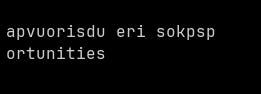
The result is nonsense. There’s an obvious solution here: have one program go first, then have another go second.
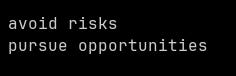
We solved the problem with a hierarchy: a rule that says, “only one process can go at a time.” The rule might be “first one to start gets to finish,” but it could also be “avoiding risks always takes precedence over pursuing opportunities.”
Each one of those approaches has problems. The challenge with concurrency is in getting all the processes to flow smoothly without stepping on each other’s toes. These same problems show up as recurring themes in the human condition, because our brains also have to solve concurrency problems.
If you always run one process to completion without switching, you’d be totally incapable of handling interruptions. Combine that with a very intelligent brain, and you might conceive of an infinite array of risks. You’d never finish avoiding them in order to be able to pursue opportunities.
We call this ‘worrying’ or ‘anxiety’ when humans beings do it, but it’s easily understood as a concurrency problem called “starvation.” All of that worrying will prevent other programs from running, programs that will make you feel better and help you function better.
On the other hand, if you do switch between processes, you have the risk of your brain constantly switching from one process to another, leading to mental activity that is energetically wasteful and unpleasant. You get something that looks very much like the gobbledy-gook above:
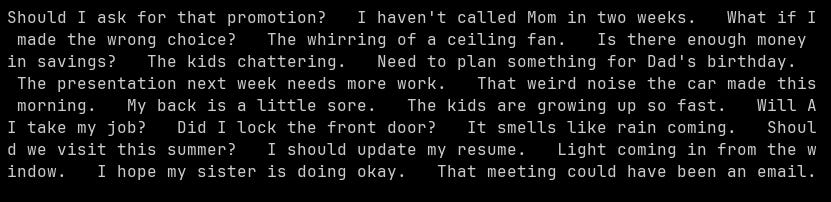
This is known as the concurrency problem of thrashing. Thrashing happens when processes waste computational power swapping back and forth between each other.
If you’re like me, your thoughts are often like this. You experience a constant stream of mental chatter. Worries, plans, hopes, and judgements fall like rain. Your thoughts ping-pong between past and future. It all adds up to nothing. Most of the worries and plans don’t happen. All the judgements tend to do is sap emotional energy without a payout.
Is that really fundamentally different from a computer program spewing nonsense on the screen?
The solution that is often proposed for this problem is that a person meditate. It’s a good solution!
When people sit down to meditate, they are developing a hierarchy: the breath matters. Everything else, not so much. There is a Buddhist teaching called the Chappana Sutta that perfectly illustrates meditation as a concurrency control technique.
The Chappanna Sutta describes the mind as being like a bunch of animals that are all chained up. Each animal wants to go to its own preferred environment: the monkey to the forest, the crocodile to the water. They all pull against each other, exhausted, until one wins. The trained mind, Buddhists say, is one that has first driven a stake into the ground. The animals can’t tug of war with each other; the stake always wins. They learn to stop fighting and just let the stake lead. That stake — mindful awareness in the body — then allows the meditator to lead the now-trained animals in a coherent direction.
This story describes a hierarchy imposed upon an unruly collection of processes, reducing the energy they waste thrashing with each other.
No, your mind isn’t made up of a bunch of animals. But it is made up of a bunch of different psychological drives, all of which compete for the limited computational bandwidth in your brain.
The mindful awareness advocated by Buddhist teachings acts as a form of concurrency control. Of course, some sharp students will complain that Buddhism isn’t really a monotheism, to which I say “Bonus points for Ravenclaw!” You have an excellent point.
Buddhism’s approach to psychological concurrency control is to detach from the world. This generally works out best for a person if they are inside the Sangha, a community of Buddhists. This technique outsources the computational load of survival to the community around it. You can see the relationship between a Buddhist temple or monastery and its surrounding community as being something like a symbiotic one: the monks provide peace, calm, and compassion. The surrounding villages provide food, resources, and protection. If each of these groups trusts the other, the system can keep working for a very long time.
That trust is the key.
Trust Reduces Contention Between Processes
Buddhist monasteries would likely not exist if they couldn’t earn the trust and well regard of the people around them. If the monasteries kept being raided and attacked by thieves, or couldn’t get enough donations, they would disappear. For their part, the monastery has implicit trust in the community around them, because they recognize worry as a perturbation of the mind, and categorize it as one of the hindrances to continuous mindful awareness.
Buddhism thus manages to solve the concurrency problem by advocating an attitude of trust towards need being met. Monotheistic religions point directly to that trust.
Buddhism reduces thrashing, effectively, by lowering demand on the CPU and adopting the fixed schedule of the Sangha. Monotheism does so by establishing the existence of a single, root process, and saying “you can trust in this thing.” The declaration of “there is only one God” means, in practice, “a single process with a single goal is the best explanation for reality. You are a child of that process.”
The monotheistic religions claim “You can trust reality itself.” That’s huge, if true. Jesus says in the sermon on the mount, essentially:
“You, like all animals, are evolutionary fitted to your niche. Animals don’t waste metabolic energy simulating possible futures, and you don’t have to, either. Your needs and desires can absolutely be integrated into a coherent strategy that will work for you to navigate reality. That strategy requires trusting reality to be navigable. You don’t need to optimize everything, just trust the environment try to do the best you can right now.”
Jesus, and the Jewish tradition he came from, advocate a parent-children relationship with reality. There’s obviously a memetic resonance there, as our relationship with our parents touches some deep emotional structures. But there’s a computational benefit, too: trusting your environment (or in a loving God, which at some level is the same thing) leads to recursive internal trust.
When you trust reality, your psychological interior does the same.
Each of the drives and desire inside of you thinks it is you. From a computational perspective, this makes sense. Each process running on a CPU is written in terms of instructions for modifying that CPU, as if it were the only process on that CPU.
The parent-children tree of processes on a CPU is explicit, built into the operating system. Every program that runs has a ‘parent’, from which it inherits some properties and permissions. In human beings, the existence of this structure depends on which operating system they are running, which set of abstract beliefs guides their attention and selects what to get done right now.
Human beings that see themselves, explicitly, as ‘children of the infinite’, can start to structure their interior psychological structures along the same hierarchical mechanism; as children of reality, they trust their parents and try to do what they think their parents want. Their internal drives will then adopt the same attitude towards them. Their fear, anger, and guilt no longer feel the need to own the entire CPU because they have deeply internalized their ultimate dependence on the process that contains them. Trust and obedience can then flow both ways.
If you treat the people around you with love and compassion — as every major wisdom tradition advocates — the different drives inside of you will do the same with each other. Your desire for material success will be loving and patient with your desire to be a good parent to your children, only in proportion to your tendency to be loving and patient with everyone you encounter. The different sub-personalities inside of you will then be less likely to fight, and more likely to defer to each other, reducing the metabolic energy you waste on internal conflict.
The end result here — of trusting reality, of being as loving as you can to the people you interact with, including yourself — is that you’ll experience more peace. That’s an experiment worth trying!
These ideas came about as a matter of personal survival; I rejected traditional religion as being irrational, and found myself using the tools of computer science and meditation to understand and debug my own thought process. If you enjoyed this essay, please consider subscribing to my substack. If you want to read the full story of how I got here, you can preorder my memoir, which will be out July 16th.
I love this, thank you. You have a gift for taking my own intuitions and making them explicit.
I love the concurrency problem framing. My thoughts can be jumbled like this “what did this person think of me doing that, am I doing enough here, this person seems to be doing so much better than me at that. I’m doing a bad job raising my son. He won’t turn out and I’ll have failed him. Why am I such a failure.” These thoughts appear like arrows out of the darkness meant to take me down. Pray without ceasing. Abide in His love. Relationship with God seems to be concurrency solution: a father, one who loves us unconditionally and wants to bless us accordingly is the ordering principle. Another metaphor is a shield. Abba, thank you for loving me and for answering my prayers. Order my thoughts. Light of the world shine on me and light my path. I need you. Amen.